
Equalising Audio
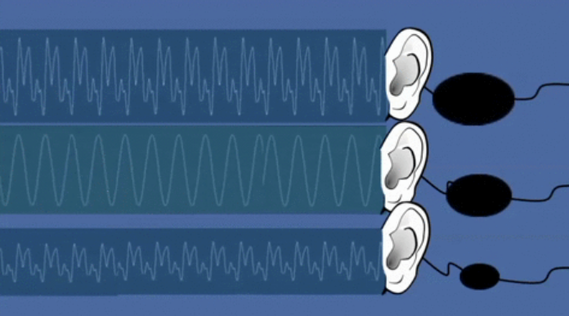
As a radio engineer at the Balanced Audio Podcast © your job is to deliver an equal listening experience at all times. You did a poll among the listeners and they are especially concerned about fluctuations in loudness. To resolve this you bought a transformer to equalise the audio, but alas, its software got corrupted during transport.
Your job is to rewrite the equalising software. As input the transformer gets $n$ amplitudes $a_1, \ldots , a_n$, with an average perceived loudness of $\frac{1}{n}\sum _{i=1}^n a_i^2$. The output should contain the same amplitudes, but renormalised by some constant positive factor, such that the average perceived loudness is $x$. There is one exception: total silence should always be preserved (i.e., when all amplitudes in the input are $0$, they should remain $0$).
Input
The input consists of:
-
One line with a two integers $n$ and $x$ ($1\leq n\leq 10^5$, $0 \leq x \leq 10^6)$, the number of amplitudes and the average perceived loudness to achieve.
-
One line with $n$ integers $a_1, \ldots , a_n$ ($\left| a_i \right| \leq 10^6$), the amplitudes.
Output
Output one line containing $n$ numbers, the renormalised amplitudes with an average perceived loudness of $x$.
Your answers should have an absolute or relative error of at most $10^{-6}$.
| Sample Input 1 | Sample Output 1 |
|---|---|
5 6 0 1 -2 3 -4 |
0 1 -2 3 -4 |
| Sample Input 2 | Sample Output 2 |
|---|---|
4 1 1 3 3 7 |
0.242535625 0.7276068751 0.7276068751 1.697749375 |
